Constitutional Market Power: Control of Demand Before Competition Begins
A party that sells nothing in a category can still decide which offers an agent considers there. A new working paper names that position constitutional market power, the fourth component of the Theory of Delegated Markets, and states it as six propositions, each with a boundary and a falsifier.
Today I submitted a working paper to SSRN, Constitutional Market Power: Control of Demand Before Competition Begins (abstract 7649358). It is a conceptual paper and reports no empirical result. When an agent chooses for a person, a rule assembles the set of offers the agent will consider, and someone writes that rule. The party that writes it shapes demand before sellers compete on price or product, and "it need not sell anything to do so." This article sets out the claim, where it sits in the program, and what remains open.
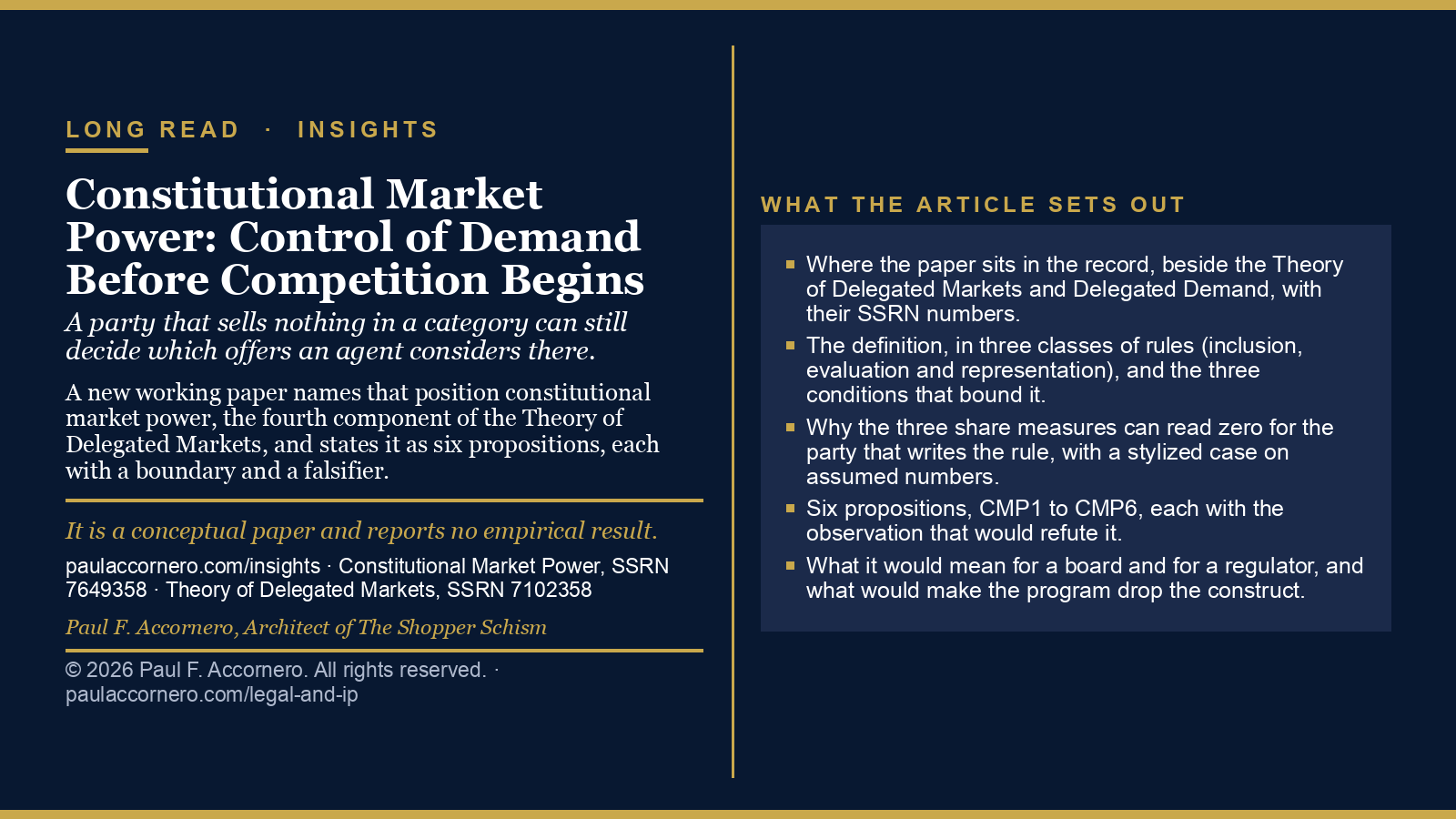
Where this paper sits in the record
The Theory of Delegated Markets (SSRN 7102358) places the Shopper Schism and the Great Decoupling in a general class: markets in which the person whose welfare is at stake hands part of a decision to a distinct decision bearer. Its Section 7 named constitutional market power and stated one proposition about it, that transaction share understates it. This is the fourth of the five companion papers it announced, and it makes that position testable.
Delegated Demand: When the Buyer Is a Verifier (SSRN 7640598), posted on 21 October 2026, supplies two pieces. Its DD1 says that as an agent's capacity to check claims rises, the seller's offer separates into a persuasion layer addressed to the person and a proof layer addressed to the rule. Whoever writes the rule therefore decides what counts as proof. Its DD3 says that where both sides of a market delegate at selection depth, the position is held by two rule-setters instead of one. The new paper works DD3 through hiring, lending and procurement. In hiring, a screening vendor licensed by many employers and the platform through which applications arrive can each hold the position, and neither hires anyone. Procurement is the benchmark: a public buyer publishes its scoring rule and its weights before the bids arrive, so the position is held in public, under law.
The definition
Constitutional market power, as the paper defines it, is the durable capacity to govern the rules, representations and infrastructures through which delegated demand is constituted before ordinary price and product competition occurs. I group the instruments into three classes. Rules of inclusion decide which offers enter the agent's consideration set. Rules of evaluation decide how the included offers are scored. Rules of representation decide how the principal's preferences are held, updated and moved.
The paper sets the construct against three downstream share measures. They are first-party sales share, intermediated transaction share and agent usage share. The case the paper is about is a party with little or no share on all three.
Three conditions separate the construct from platform governance, ranking power and foreclosure. The first is delegation at selection depth: the agent's rule decides which offer wins, at depth D3 or above on the scale of the foundational paper. The second is commonality: one rule serves many principals at once, so a seller the rule excludes is excluded for every principal whose agent runs it, where the rule does not read the principal's own preferences. The third is durability: control of the rule persists, and no single seller can undo it by a move on price or product. Where all three hold, the intermediary governs both inclusion and selection, for many principals at once, through an instrument the price system does not discipline.
Why the share measures can read zero
The paper divides a seller's delegated demand into two probabilities: the probability that its offer enters the agent's consideration set, and the probability that the agent selects it once included. It is an accounting identity and proves nothing by itself. None of the rule-setter's three shares enters the equation, while its rules enter both probabilities.
Under human choice, a ranking moves which options a person searches and leaves the choice to the person (Ursu, 2018). Under delegation, the rule reaches the selection as well.
A stylized case in the paper, with assumed numbers, shows the size of the gap. Half the purchase occasions in a category are delegated, spread evenly across three agent providers. All three admit an offer only if it meets one evidence standard, owned by a party that sells nothing, runs no marketplace and operates no agent. Ten sellers each start with a tenth of delegated demand. The owner tightens the standard so that two sellers fail it, and their inclusion probability falls from 0.9 to 0.1. Prices do not change. Each of the two loses about 88 percent of its delegated demand and about 44 percent of its total demand. On all three share measures the owner of the standard reads zero before and after.
The propositions, and how each could fail
CMP1, control of the choice set without transaction share. Where a material share of demand is delegated at selection depth, a party with little or no share on the three measures can control which offers enter agents' consideration sets, and those measures will understate the power that control confers.
CMP2, pre-competitive control. Holding posted prices and the set of available sellers fixed, a change in an intermediary's rules of inclusion or evaluation changes seller outcomes and principal welfare.
CMP3, self-preferencing at the evidence layer. An intermediary can favor affiliated offers through eligibility rules or the weighting of evidence, without overt manipulation of ranking, and principals detect that favor less often than they detect overt ranking bias.
CMP4, machine-legibility exclusion. Sellers that fail an intermediary's legibility, protocol or evidence standard lose a larger proportion of their delegated demand than of their demand from human buyers.
CMP5, cross-market scope. An intermediary whose rules serve several categories holds power in each that rises with its footprint across them.
CMP6, common-architecture concentration. Where one rule serves a large share of delegated demand and its weights vary less across principals than their measured preferences do, its choices are more concentrated than those principals' direct choices would be. The concentration persists longer where principals cannot move their preference capital to another agent.
What it would mean for a board and for a regulator
For a company that sells where agents choose, the decomposition separates two questions: whether the offer enters the agent's consideration set, and whether it wins once there. CMP4 treats the cost of meeting a legibility or evidence standard as a cost of access to delegated demand, set by a party with interests of its own. The paper's question for a seller is who sets that standard, and on what terms it can be met.
For a competition authority, Section 9 lists six things it would have to measure: the delegated share of demand in each category; cross-agent consideration-set concentration; the effect of rule changes at fixed prices; favoring at the evidence layer; the legibility standard as an access term; and the portability of preference capital. The Digital Markets Act already reaches ranking by virtual assistants; whether eligibility rules and evidence weights count as ranking is left open. The paper proposes no thresholds, and nothing in it is legal analysis.
What is open, and what would make me drop it
The claim is narrower than the title suggests. The paper does not argue that agent providers hold market power today, or that any firm has abused it. The measurement object, cross-agent consideration-set concentration, is proposed and left unspecified: its statistic, its attribution rule and its observation protocol are open, and the paper asks that they be registered before any outcome data are seen. None of its three designs has been run, and no platform or firm has agreed to take part. The construct must pass two tests in order. It fails on layer stability if no stable layer of consideration-set control can be measured across agents. It fails on understatement if, once that control is measured, intermediary influence tracks the three share measures with no residual, and in that case "the program should drop it." A surviving residual would show the share measures insufficient, and would leave open whether the construct is distinct from theories of standards, platform governance, dependence and exclusion. The paper is a working paper in SSRN review, and "it must not be cited as evidence for any effect."
Sources
The theory this paper extends
- Accornero, P. F. (2026). The Theory of Delegated Markets: Foundations of a Theory of Economic Agency. SSRN Working Paper 7102358. https://ssrn.com/abstract=7102358
- Accornero, P. F. (2026). Delegated Demand: When the Buyer Is a Verifier. A Demand-Side Theory of Agentic Markets Across Shopping, Hiring, Lending, and Procurement. SSRN Working Paper 7640598. DOI 10.2139/ssrn.7640598. https://ssrn.com/abstract=7640598
My earlier work cited above
- Accornero, P. F. (2025). The Shopper Schism: Structural Disaggregation of Consumer and Shopper in AI-Mediated Commerce. SSRN 5753722. https://ssrn.com/abstract=5753722
- Accornero, P. F. (2025). The Great Decoupling: How Autonomous AI Agents Are Dismantling the Direct Brand-Consumer Relationship. SSRN 5708625. https://ssrn.com/abstract=5708625
Other sources
- Ursu, R. M. (2018). The Power of Rankings: Quantifying the Effect of Rankings on Online Consumer Search and Purchase Decisions. Marketing Science, 37(4), 530-552. https://doi.org/10.1287/mksc.2017.1072
- Regulation (EU) 2022/1925 (Digital Markets Act), Articles 2(2), 2(22) and 6(5). https://eur-lex.europa.eu/legal-content/EN/TXT/?uri=CELEX:32022R1925
The paper
- Accornero, P. F. (2026). Constitutional Market Power: Control of Demand Before Competition Begins. SSRN Working Paper 7649358, 21 October 2026.
Available at SSRN: https://ssrn.com/abstract=7649358
Paul F. Accornero is the founder of The AI Praxis, a research practice established in 2024, and the author of The Algorithmic Shopper: Rethinking Growth, Strategy, and Brand Power in an AI-First World (St. Martin's Press, 13 April 2027). He is among the top one percent of SSRN authors by downloads, with more than 30 papers on the structural transition from human-centric to algorithm-centric commerce.
Research: ssrn.com/author=8182896 · The Algorithmic Shopper (St. Martin's Press, April 2027), U.S. Copyright Reg. No. TXu 2-507-027.
Agent Intent Optimisation (AIO) and The Shopper Schism are registered trademarks in the UK and the EU.
© 2026 Paul F. Accornero. All rights reserved. · paulaccornero.com/legal-and-ip