Delegated Demand: A Theory of the Buyer That Checks
The Shopper Schism was the first instance. A new working paper states delegated demand as the demand side of the Theory of Delegated Markets and reads it across shopping, hiring, lending and procurement.
Today I posted a working paper on SSRN, Delegated Demand: When the Buyer Is a Verifier (abstract 7640598). It asks a question I have carried since I first wrote about the Shopper Schism. Is the split I described in consumer markets one case of something more general, or is shopping a story of its own? The paper argues that a single mechanism runs through shopping, hiring, lending and procurement, and that the mechanism can be stated, bounded and tested. This article sets out what the paper claims, where it sits in the record, and what would prove it wrong.
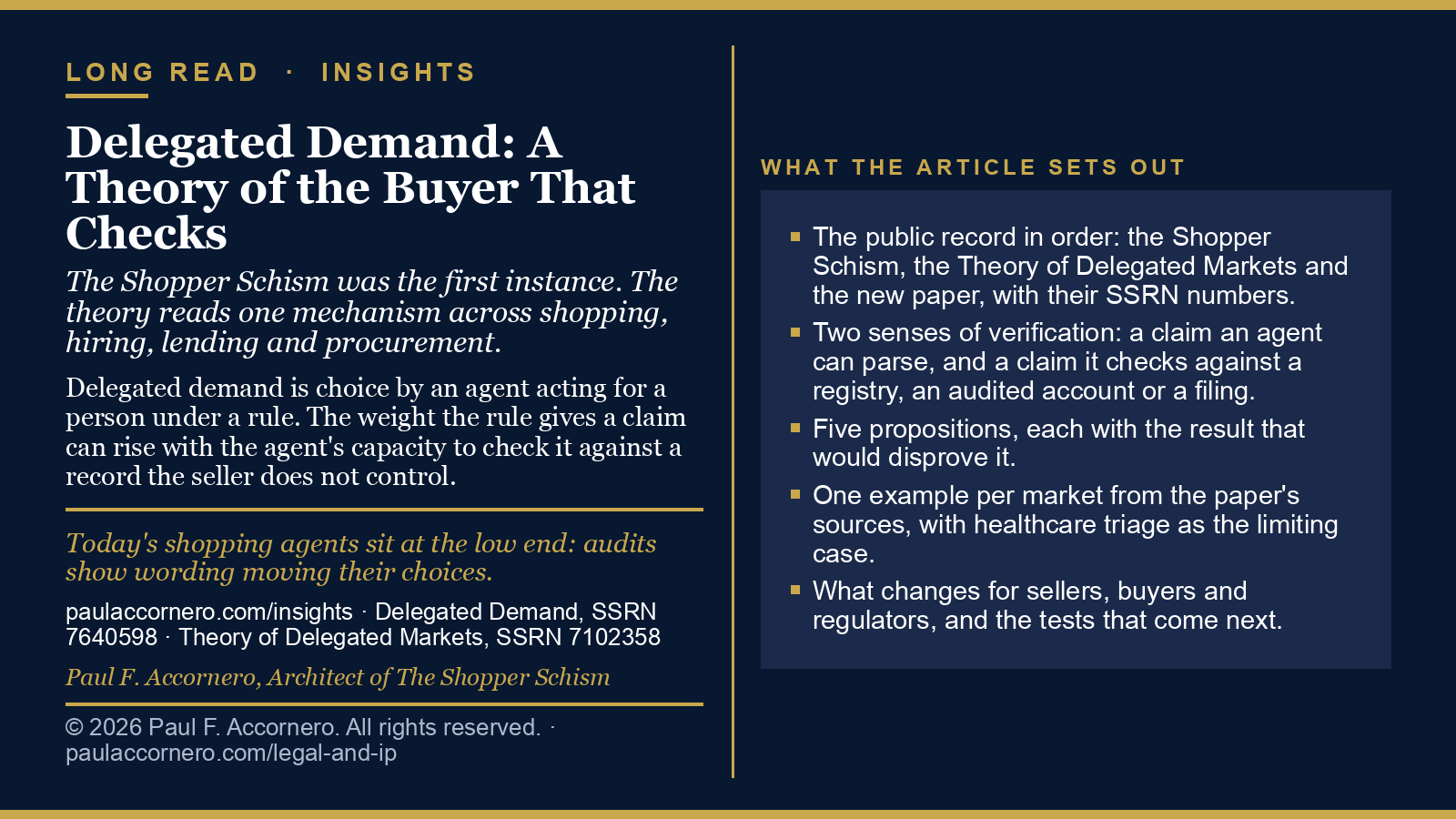
Where this paper sits in the record
I want the dates on the page, because in a young field precedence rests on the public record.
- In 2025 I posted The Great Decoupling (SSRN 5708625) and The Shopper Schism (SSRN 5753722). The Shopper Schism is the structural separation, in delegated categories, of the consumer who experiences value from the shopper who executes the purchase. The Great Decoupling is its consequence on the supply side: the brand loses its direct line to the consumer once an agent sits between them. The book manuscript from which both derive is registered with the US Copyright Office under TXu 2-507-027, with an effective date of 12 July 2025.
- In January 2026 I carried the Schism beyond consumer goods, into tourism and professional services (SSRN 5998716).
- In July 2026 I put the Theory of Delegated Markets on SSRN (abstract 7102358). It places the Schism and the Decoupling in a general class: markets in which the person whose welfare is at stake transfers part of a decision to a distinct decision bearer, which acts through a representation of that person's preferences.
- On 20 October 2026 I posted the paper this article describes (SSRN 7640598). It states delegated demand as the demand side of that theory, with the Shopper Schism as its first instance.
I was the first researcher to define agentic commerce as a formal academic discipline. For the new theory I make a narrower claim, in the form the paper uses. To my knowledge, it is the first statement of a demand-side theory that treats the verifying agent as the buyer across consumer, labor, credit and procurement markets. Each of its parts has close precursors, and the paper names them. Michal Gal and Niva Elkin-Koren expected suppliers facing algorithmic consumers to spend less on marketing aimed at human biases and more on product information that algorithms can observe (2017). Niraj Dawar described the coming contest for the attention of AI assistants (2018). Don Scheibenreif and Mark Raskino wrote a practitioner book on machine customers for Gartner (2023). Two recent working papers analyze the economics of AI agents (Shahidi and colleagues, 2025; Lucier and colleagues, 2026). Algorithmic hiring and algorithmic lending are mature empirical fields. What the paper adds is one mechanism read across these markets, with the buyer's agent as the reader in each.
The definition
Delegated demand is choice by a decision bearer acting for a distinct welfare bearer. The decision bearer applies a rule to the inputs it can parse, and the weight the rule gives a claim can rise with the bearer's capacity to check that claim against a record outside the offer.
The welfare bearer is the person or organization whose welfare the choice affects. The decision bearer is whatever applies the rule: a shopping agent, a screening model, an underwriting model, a scoring rule published before the bids arrive. The rule may be a mandate the principal wrote, a model a firm trained, or a published award formula. The demand is delegated because the party that decides is not the party whose welfare the decision affects.
The structure is old. Public buyers have bought under published rules for decades. Agents change who reads the rule and how much it costs to check a claim against a record.
What it means for an agent to verify a claim
The paper depends on one distinction. A claim is machine-legible when the agent can parse it in the form its rule takes: a structured attribute, a tagged field, a number in a schema. A claim is institutionally verified when the agent checks it against a record the seller does not control: a registry, an audited account, a regulator's filing, a certificate, a platform's own transaction log. Legibility makes a claim usable. Verification makes it costly to fake.
An agent can parse a product description and score it without checking anything, and the audits of today's shopping agents show it happening. In the audit by Allouah and colleagues (2025), sellers moved a buying agent's choices by rewriting product descriptions for the query while the product stayed the same, and the agent's position bias varied across model providers and versions. Kumar and Lakkaraju (2024) showed that a crafted text sequence on a product page raised its chance of being an assistant's top recommendation.
So the paper makes no claim that today's agents ignore what they cannot check. They sit at the low end of the one variable the theory depends on, the agent's capacity to check. That capacity has two parts. The first is an outside record the agent can reach, which is a fact about institutions. The second is the weight the agent's rule places on the result of the check, which is a design choice, read from the rule as written. At the high end of the scale sits public procurement in the European Union, where the law requires award criteria that let the buyer verify what a tenderer states.
What the theory predicts, and what would disprove it
The paper states five propositions, DD1 to DD5. Each comes with a boundary and a falsifier, so that a reader can see what evidence would count against it.
DD1: the offer divides. Holding the product fixed, as the buyer's capacity to check claims rises, the seller's offer separates into a persuasion layer addressed to the person and a proof layer addressed to the rule, and the return to persuasion falls relative to the return to proof. In consumer markets I called the result the Great Decoupling; DD1 says it is general and a matter of degree. The offer keeps its persuasion layer for as long as a person reads part of it, through the share of demand in a category that is not delegated, or through the veto a person keeps over what the agent selects. DD1 says nothing where the agent cannot reach a record, or where its rule gives the check no weight. It is disproved if, with the product held fixed, the gap between the agent's written rule and its behavior fails to narrow as the rule checks a growing share of claims against a record, so that description the rule says to ignore moves as much of the agent's choice as before.
DD2: the cheapest signal loses its value first. The informational value of a signal falls as the cost of altering it, without altering the attribute it describes, falls. A sentence costs less to rewrite than an ingredient, and a cover letter less than a track record, and generative tools push the cost of a sentence toward zero for everyone at once. Where law or audit binds a description to its attribute, as with a regulated label or an audited account, the decline is slow. It is disproved if, across markets, the loss of a signal's informativeness turns out to be unrelated to the measured cost of altering it.
DD3: two sides, two rule-setters. Where both the buying side and the selling side of a market delegate evaluation at the depth where an agent selects, each side's claims must pass the other side's rule. In the Theory of Delegated Markets I argued that whoever sets the evaluation rule holds power that transaction share does not measure. With two rules, that power is split between two rule-setters. Where one side's delegation stops at recommendation, the market reverts to the one-sided case. It is disproved if, in a market where both sides delegate at selection depth, outcomes are explained by one side's rule alone.
DD4: recursion has a speed. When the choices an agent executes become the data that updates its rule, delegated choice becomes recursive. DD4 says the speed of that loop rises with the volume of executed outcomes per period and with the share of them that re-enter the rule. A grocery agent's rule sees weekly outcomes pooled across many households, so drift should become measurable within months. A screening model sees hires, which are rare for any one employer and slow to show their quality, so its drift is slow and hard to see. A procurement rule fixed by law for the life of a tender has no recursion within it. It is disproved if rule drift per period is unrelated to the volume of executed outcomes that re-enter the rule.
DD5: verification is where the market moves, where a record exists. Where a claim can be checked against an outside record for less than the claim is worth, the verifiable share of the offer rises with the share of demand delegated to a rule that checks, and the return to an unverifiable claim falls toward zero. The fall to zero holds at full delegation; while a person reads any part of the offer, persuasion keeps a reader. Where no record exists at that cost, the rule reaches for a proxy, and the loss the foundational theory calls representation loss returns. It is disproved if, in a market where the record exists at that cost, the verifiable share of offers fails to rise as more demand is delegated to rules that check, or the return to unverifiable claims fails to fall.
How the theory reads in each market
The paper compares the markets on six institutional parameters: the direction of delegation, the welfare criterion of each delegating side, the legal regime, the cost of gaming, the owner of the rule, and the speed of recursion. The entries are my judgments, set out as a typology; no one has validated them as an index.
Shopping
The consumer delegates, most sellers do not, and a platform or model provider sets the rule. Shopping is the furthest into deployment and the first instance, the one the Shopper Schism describes. The example from the paper's sources is the audit of buying agents by Allouah and colleagues (2025), in which rewritten descriptions moved the agent's selections while the products stayed the same. The paper treats that audit as the low-capacity baseline against which DD1 would be measured, and says that it is not evidence for DD1.
Hiring
The employer, as the buyer of labor, screens applications by model. The candidate, as the seller, can rewrite the persuasion layer at almost no cost and can search with an agent of their own. Cowgill, Hernandez-Lagos and Wright (Management Science, forthcoming) found in experiments on hiring and on startup investing that giving senders access to generative tools lowered screening accuracy by 4 to 9 percent, while improving it among senders from non-English-speaking countries. Galdin and Silbert (2025) found that employers stopped paying a premium for tailored applications once language models arrived. Wiles, Munyikwa and Horton (2025) found that writing assistance on job seekers' resumes raised hires without lowering employer satisfaction. The evidence is mixed, and DD2 holds it only as an ordering. Isabel Fernández-Mateo frames each stage of the hiring funnel as decided by both employers and candidates, with AI shaping both sides (2025). DD3 adds a question that literature leaves open: what a candidate's agent can verify about the employer.
Lending and capital allocation
The borrower is the buyer of credit; the lender sells it and screens borrowers by model. The lender's side has a mature literature. Bartlett, Morse, Stanton and Wallace (2022) found that algorithmic lenders in the US mortgage market discriminate in pricing, by less than face-to-face lenders, and found no discrimination by those lenders in approval. The legal regime already binds the lender's rule to an explanation: in a 2022 circular, the Consumer Financial Protection Bureau stated that a creditor using a complex algorithm must give specific and accurate reasons for an adverse action, and cannot plead the complexity of its technology. The borrower's agent rests on a practitioner source, an Oliver Wyman note of January 2026 arguing that agents are becoming an acquisition channel for retail banks. In capital allocation, operating companies that file financial statements with the US Securities and Exchange Commission must tag them in Inline XBRL, a format readable by people and machines alike, under a rule adopted in 2018. An investor's agent that read the tagged statements and discounted the narrative would be DD1 at work in a market where the legible layer came before the agent. I state that instance as structure only, because I know of no study of agents acting for investors.
Procurement
Public procurement is among the oldest delegated markets. The scoring auction formalizes it (Che, 1993). European law makes the delegated structure explicit. Article 67 of Directive 2014/24/EU awards contracts to the most economically advantageous tender, requires award criteria to come with specifications that allow the information tenderers provide "to be effectively verified," and requires the weighting of the criteria to be stated in the procurement documents. Verifiability was written into the award rule before any agent read a bid. The theory's claim here is modest. It says who reads the proof layer next, a model in place of an evaluation committee, and it predicts that a supplier's division of effort between relationship selling and meeting the published rule becomes the DD1 division.
Healthcare triage, the limiting case
Triage has no seller and so no offer to divide, which is why the paper treats it as a limiting case. It illustrates the foundational theory's first proposition, representation loss, and the warning in the second clause of DD5. In the study by Obermeyer and colleagues (Science, 2019), a widely used health-care algorithm predicted cost as a proxy for need. Because less is spent on Black patients at a given level of illness, Black patients held 17.7 percent of the places in the group flagged for extra help, where a corrected rule would give them 46.5 percent. No conflicting incentive is needed to explain that result. It is what a delegated rule does when the attribute that counts cannot be checked and the rule reaches for what it can measure.
What it changes for sellers
For a seller, the first question is which reader the offer meets. Where the rule checks attributes against an outside record, the money belongs on the attribute and on the record that confirms it, because DD2 says the description loses its value first. Kleinberg and Raghavan (2020) show formally when a scoring rule can induce effort that improves the attribute instead of gaming the score. Where the rule is a model reading copy with no record behind it, the audits say description moves choice today, and the theory's question for that seller is how long the effect will last.
A seller should also find out who writes the rule its offer is judged by, because the rule-setter holds a position that market share does not show. And it should keep the persuasion layer for the people who read it: the share of demand in a category that is not delegated, and the person who keeps a veto over what the agent picks.
This is where my earlier work on Agent Intent Optimisation (AIO)® sits. Agent Intent Optimisation (AIO) is the discipline that runs alongside SEO when the buyer is a machine: engineering a product's data, claims, and commercial signals so that an AI agent can retrieve them, read them, and verify them independently. Where SEO competes for human attention and generative engine optimisation (GEO) competes for citation inside a generated answer, Agent Intent Optimisation (AIO) competes for the selection itself, and an agent selects on what it can check rather than on what it is told. Whether and how today's buying agents select that way is the question a pre-registered experiment is measuring now; nothing here reports its result. Delegated demand gives that practice its demand-side theory.
What it changes for buyers
On the buying side sits whoever writes or chooses the rule: a consumer who configures an agent, an employer who buys a screening model, a bank that deploys an underwriting model, a public authority that publishes award criteria. The theory treats part of the capacity to check as a design choice. A rule that gives weight to a check makes claims costly to fake. A rule that reads copy can be moved by copy.
The second clause of DD5 is the warning for every buyer. Where the attribute that counts has no record behind it, a rule reaches for a proxy, and the proxy can fail the people the rule exists to serve, as the triage case shows. In the two-sided markets, the buyer is also being read. A candidate's agent can check what an employer states about pay and progression, and the paper predicts that employers whose facts are machine-verifiable will fare differently in the candidate pool from those whose facts appear only in a brochure.
What it changes for regulators
The Theory of Delegated Markets argued that transparency alone does not repair the failures of delegated markets, and that they need institutions: portable preference capital, separable mandate and execution layers, computational fiduciary duties, independent agent auditors, contestable consideration sets, and bounded autonomy with human escalation. Delegated demand adds one observation. In a delegated market, the reader of what these institutions produce is often an agent.
Several of the records already exist. The procurement directive builds verification into award criteria. The US credit regime binds a lender's algorithm to stated reasons. The US securities regime has required machine-readable financial statements since 2018. The disclosure literature shows that unraveling, the process by which a seller's silence comes to be read against it, needs disclosure that is cheap for the seller, information that can be verified, and a reader who draws the right inference from silence (Grossman, 1981; Milgrom, 1981; Milgrom, 2008). Delegation makes that inference mechanical, because a rule that scores an absent attribute as absent does not assume the best about what is missing. Delegation does not create the record. Whether a record exists at a cost below the claim's value is a question of institutions, and in my reading that is where regulators have the most influence over whether delegated markets reward the attribute or its description.
What the research program does next
Every proposition in the paper is stated for test, and none is tested there. The paper has no data, no experiment and no measurement, and it should not be cited as evidence for any effect.
The first test is of DD1 in a single market. Hold the offers fixed, vary the persuasive wording and the supporting evidence independently, vary the agent's access to an outside record against which the evidence can be checked, pin the model, the prompt and the decoding, and give people and agents the same objective. DD1 predicts that the effect of wording on the agent's choice falls as its access to the record rises. DD2 needs repeated rounds in which the cost of altering a signal is varied and the link between signal and attribute is measured. A comparison across markets should show the widest gap between what persuades and what passes where gaming is cheapest, wider in hiring than in procurement, and DD4 predicts drift within months in shopping and within years in hiring. DD3 needs studies of what candidates' agents can verify about employers, and whether employers with machine-verifiable facts gain share of the candidate pool.
The paper also specifies, as a design, a field study in a graduate strategy course, in which participants write the same offer once for a human evaluator and once for an agent under a published rule. It has not been run, and no site has agreed to it. Separately, the pre-registered experiment named above, on four language-model buying agents and covering admission, verification and schedules, is running now (OSF, DOI 10.17605/OSF.IO/GPBUK).
The result that would make me abandon the theory is stated under DD1. If an agent's rule comes to check a growing share of claims against a record and the gap between that written rule and its behavior does not narrow, then the Shopper Schism and the Great Decoupling stay observations about consumer markets, and I was wrong to generalize them.
Sources
The paper and the theory it extends
- Accornero, P. F. (2026). Delegated Demand: When the Buyer Is a Verifier. A Demand-Side Theory of Agentic Markets Across Shopping, Hiring, Lending, and Procurement. SSRN Working Paper 7640598, 20 October 2026. https://ssrn.com/abstract=7640598
- Accornero, P. F. (2026). The Theory of Delegated Markets: Foundations of a Theory of Economic Agency. SSRN Working Paper 7102358. https://ssrn.com/abstract=7102358
My earlier work cited above
- Accornero, P. F. (2025). The Shopper Schism: Structural Disaggregation of Consumer and Shopper in AI-Mediated Commerce. SSRN 5753722. https://ssrn.com/abstract=5753722
- Accornero, P. F. (2025). The Great Decoupling: How Autonomous AI Agents Are Dismantling the Direct Brand-Consumer Relationship. SSRN 5708625. https://ssrn.com/abstract=5708625
- Accornero, P. F. (2026). The Shopper Schism Beyond Consumer Goods: Algorithmic Agency in Tourism, Professional Services, and the Universal Logic of Delegated Commerce. SSRN 5998716. https://ssrn.com/abstract=5998716
- Accornero, P. F. (2025). From SEO to AIO: Agent Intent Optimization in the Age of Algorithmic Shoppers. SSRN 5511758. https://ssrn.com/abstract=5511758
Other sources
- Allouah, A., Besbes, O., Figueroa, J. D., Kanoria, Y., & Kumar, A. (2025). What Is Your AI Agent Buying? arXiv 2508.02630. https://arxiv.org/abs/2508.02630
- Kumar, A., & Lakkaraju, H. (2024). Manipulating Large Language Models to Increase Product Visibility. arXiv 2404.07981. https://arxiv.org/abs/2404.07981
- Gal, M. S., & Elkin-Koren, N. (2017). Algorithmic Consumers. Harvard Journal of Law and Technology, 30(2), 309-353.
- Dawar, N. (2018). Marketing in the Age of Alexa. Harvard Business Review. https://hbr.org/2018/05/marketing-in-the-age-of-alexa
- Scheibenreif, D., & Raskino, M. (2023). When Machines Become Customers. Gartner (practitioner source).
- Shahidi, P., Rusak, G., Manning, B. S., Fradkin, A., & Horton, J. J. (2025). The Coasean Singularity? NBER Working Paper 34468. https://www.nber.org/papers/w34468
- Lucier, B., and colleagues (2026). Agentic Markets: Equilibrium Effects of Improving Consumer Search. arXiv 2603.25893. https://arxiv.org/abs/2603.25893
- Cowgill, B., Hernandez-Lagos, P., & Wright, N. L. (2026). Does AI Cheapen Talk? Management Science, forthcoming. https://doi.org/10.1287/mnsc.2024.07027
- Galdin, A., & Silbert, J. (2025). Making Talk Cheap: Generative AI and Labor Market Signaling. arXiv 2511.08785. https://arxiv.org/abs/2511.08785
- Wiles, E., Munyikwa, Z. T., & Horton, J. J. (2025). Algorithmic Writing Assistance on Jobseekers' Resumes Increases Hires. Management Science, 71(12). https://doi.org/10.1287/mnsc.2024.04528
- Fernández-Mateo, I. (2025). How Generative AI Is Transforming Hiring in Organizations. Journal of Organization Design, 15(1). https://doi.org/10.1007/s41469-025-00197-1
- Bartlett, R., Morse, A., Stanton, R., & Wallace, N. (2022). Consumer-Lending Discrimination in the FinTech Era. Journal of Financial Economics, 143(1), 30-56.
- Consumer Financial Protection Bureau (2022). Circular 2022-03: Adverse Action Notification Requirements in Connection with Credit Decisions Based on Complex Algorithms. https://www.federalregister.gov/documents/2022/06/14/2022-12729/consumer-financial-protection-circular-2022-03-adverse-action-notification-requirements-in
- Oliver Wyman (2026). Will AI Agents Separate Banks from Their Customers? (practitioner source). https://www.oliverwyman.com/our-expertise/insights/2026/jan/ai-agents-separate-banks-from-customers.html
- Securities and Exchange Commission (2018). Inline XBRL, Release No. 33-10514. https://www.sec.gov/structureddata/osd-inline-xbrl.html
- Che, Y.-K. (1993). Design Competition Through Multidimensional Auctions. RAND Journal of Economics, 24(4), 668-680.
- Directive 2014/24/EU on public procurement, Article 67. https://eur-lex.europa.eu/legal-content/EN/TXT/?uri=CELEX:32014L0024
- Obermeyer, Z., Powers, B., Vogeli, C., & Mullainathan, S. (2019). Dissecting Racial Bias in an Algorithm Used to Manage the Health of Populations. Science, 366(6464), 447-453. https://doi.org/10.1126/science.aax2342
- Kleinberg, J., & Raghavan, M. (2020). How Do Classifiers Induce Agents to Invest Effort Strategically? ACM Transactions on Economics and Computation, 8(4).
- Grossman, S. J. (1981). The Informational Role of Warranties and Private Disclosure about Product Quality. Journal of Law and Economics, 24(3), 461-483.
- Milgrom, P. R. (1981). Good News and Bad News: Representation Theorems and Applications. Bell Journal of Economics, 12(2), 380-391.
- Milgrom, P. (2008). What the Seller Won't Tell You: Persuasion and Disclosure in Markets. Journal of Economic Perspectives, 22(2), 115-131. https://doi.org/10.1257/jep.22.2.115
Paul F. Accornero is the founder of The AI Praxis, a research practice established in 2024, and the author of The Algorithmic Shopper: Rethinking Growth, Strategy, and Brand Power in an AI-First World (St. Martin's Press, 13 April 2027). He is among the top one percent of SSRN authors by downloads, with more than 30 papers on the structural transition from human-centric to algorithm-centric commerce.
Research: ssrn.com/author=8182896 · The Algorithmic Shopper (St. Martin's Press, April 2027), U.S. Copyright Reg. No. TXu 2-507-027.
Agent Intent Optimisation (AIO) and The Shopper Schism are registered trademarks in the UK and the EU.
© 2026 Paul F. Accornero. All rights reserved. · paulaccornero.com/legal-and-ip