Your Commercial Policy Was Written for a Shopper Who Never Checks
Almost a year ago I left my senior commercial role to test what I had asserted in my book. The test is done. Most companies still run a policy built for a shopper they can manage by channel. The shopper now arriving is an algorithm. It checks, it compares, and it leaves out what it cannot verify.
Almost a year ago I stepped out of my senior commercial role. The last of those roles was group chief commercial officer of a major European publicly listed consumer goods group, at the end of three decades of commercial leadership that included years at L'Oréal in Asia-Pacific. I left my role to study and test what I had asserted in my book, The Algorithmic Shopper, which I finished in 2025 and which St. Martin's Press publishes in April 2027.
The market did not wait for my test. Mastercard's 2026 report predicts one in ten online shoppers will routinely use AI agents to shop and pay by 2030.
The policy I lived
Take out your commercial policy and read it again.
It has a channel architecture. Offline, online and direct each get their own terms. It splits product variants by channel: a code here, a pack size there, a name that differs just enough to stop a shopper from comparing. It has price corridors that hold the gaps between those channels. It has trade terms that pay retailers for facings. And it has a scorecard that measures all of it against a person walking an aisle or scrolling a page.
Every line rests on one assumption. The shopper can be managed by channel. The shopper sees what you put in front of them. And the shopper rarely checks what sits in the other channel.
I lived this policy for three decades at the top of large commercial organisations. I know how it is built and why it worked. It worked because the shopper could not check, and would not bother. So when I call it obsolete, I am saying it about my own work.
The experiment
The journey took me to the first pre-registered experiment on Proof-Based Pricing. To my knowledge, it is also the first scientific test of how an algorithmic shopper views price. Four AI buying agents chose among offers. The offers differed in how a seller's claim and price were shown. I fixed the design and the analysis before a single answer was scored. The results paper, Proof Before Price, is public on SSRN.
What I found
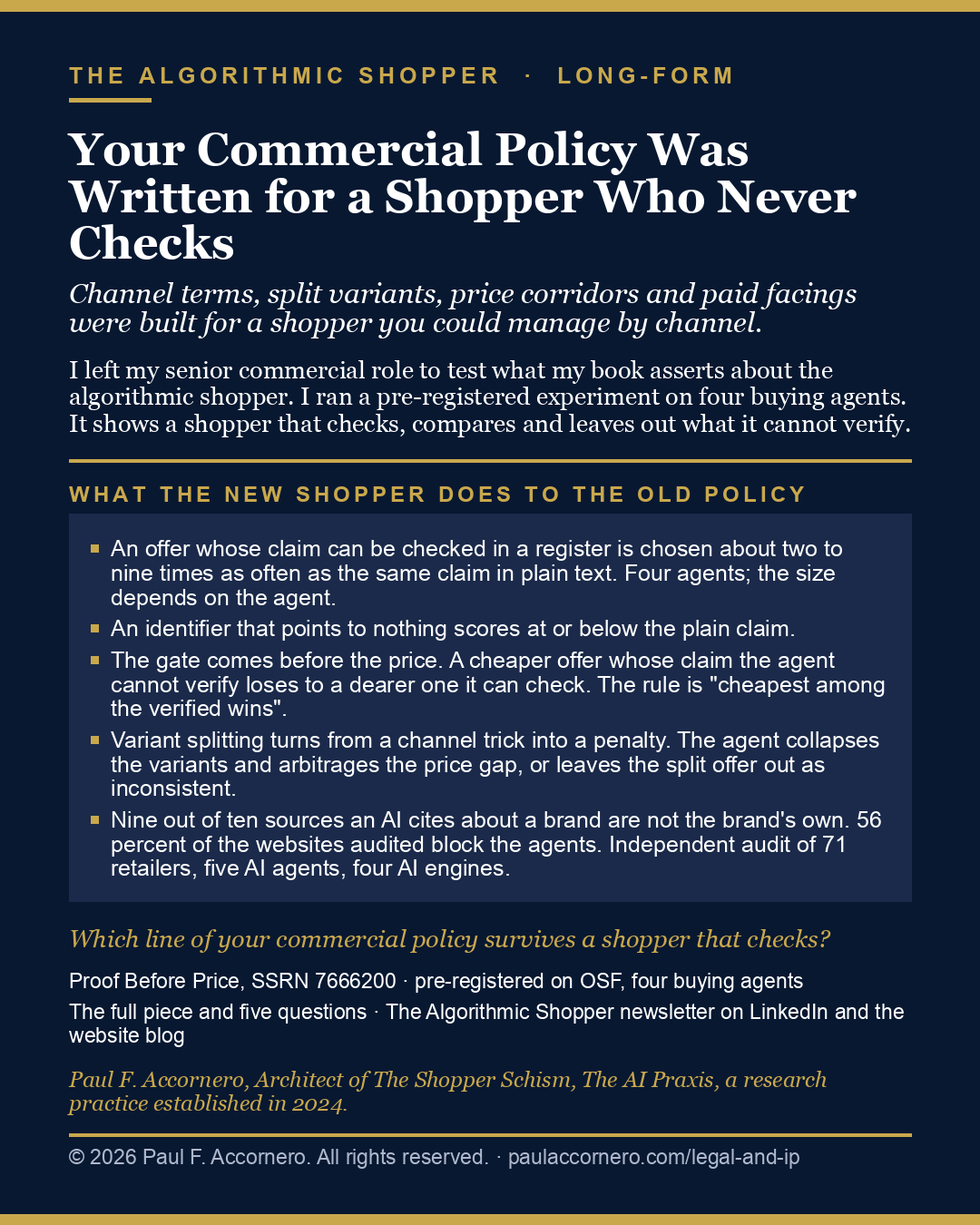
A claim the agent can check wins. An offer whose claim can be checked in a register was chosen about two to nine times as often as the same claim written as plain text. How much depended on the agent. It held on all four.
A proof that fails the check earns nothing. An identifier that points to nothing scores at or below the plain claim.
Stating the terms wins too. A price schedule the agent can run, which also states its terms, was chosen about one and a half to three times as often as the same price posted on its own.
One prediction from my earlier work did not hold, and the paper says so. The labels-only offer is considered every time and selected about as often as the structured one, with selection falling smoothly with price. My earlier work was built on observation, when no experiment existed. This one moves the field from observation to quantification, which is how a new field of study grows.
A second round of tests is now scored. It shows that the word on the proof changes the choice. It also shows that the way a price formula is built makes a difference, compared with a plain price list. The specific data points and details are available from all the testing I have done over these last several months through my research at The AI Praxis.
The gate before the price
Read those results with a commercial eye and one rule comes out of them. The gate comes before the price. A cheaper offer whose claim the agent cannot verify loses to a dearer one it can check. The rule is "cheapest among the verified wins".
Now hold that rule against the oldest trick in your policy. Variant splitting exists to defeat comparison. A different code for the discounter. A different name for online. A cosmetic difference that keeps two prices from meeting.
"Where the differences are cosmetic and unverifiable, two things happen, both bad for the old trick: either the agent collapses the two into one offer set and arbitrages the price gap at once, or the split catalogue reads as inconsistency, and inconsistency is risk, and the offer the agent cannot parse is left out. The trick does not just stop working; it turns into a penalty."
Your corridors were built on the same assumption. So were your trade terms. You are paying for shelf position in front of a reader that does not look at the shelf.
What the agents find when they look for you
In August 2026 I ran an independent audit. It covered five AI agents, four AI engines and 71 retailers around the world. Nine out of ten sources the AI cites about a brand are not the brand's own. Other people's pages, reposts and reviews describe you to the agent.
And 56 percent of the websites I studied block the agents. Bot defenses built in 2015 are self-defeating in 2026.
The payment networks are building for agents anyway. Visa reports hundreds of completed agent-initiated transactions. It expects millions of consumers to use agents for purchases by the 2026 holiday season. Google's Agent Payments Protocol carries signed mandates for intent, cart and payment. OpenAI and Stripe's Agentic Commerce Protocol sits behind Instant Checkout in ChatGPT. Amazon objected that Meta's Muse agent did not identify itself while browsing its site. The law has not decided who is liable when an agent goes beyond its mandate. The agent makes the choice; who presses the button is a question of mandate, platform rules and liability, now being settled.
Your policy was written as if none of this were open.
Five questions for your next commercial review
Put them to your team and listen to the answers.
- When the agent is the channel, on what terms does it see your offer, and who in your company sets them?
- How many of your product codes exist only to stop a comparison, and what happens to them when the comparison is made for the shopper?
- Which of your price gaps could you defend to a reader that asks for the reason and checks it?
- What do your trade terms buy, and can an agent see any of it?
- Does one number on your scorecard tell you how often an agent selects you, at your price, on each surface where it shops?
If you cannot answer three of the five, your policy was written for a shopper who is leaving.
Why I am the one asking
I was the first researcher to define agentic commerce as a formal academic discipline, and I have published nearly 40 papers on SSRN, among the top one percent of SSRN authors by downloads. I have taught five classes as a guest lecturer at the Harvard Division of Continuing Education, the latest in August 2026. Next week I speak at UCL, on the Thinkers50 x UCL panel with Prof Paolo Taticchi on Tuesday 3 November, and at the LSE on Wednesday 4 November at the invitation of Prof Brunello Rosa. On 13 November I speak on Prof Costas Markides's Senior Executive Programme at London Business School.
I lived the old policy for three decades. I have now measured the new shopper. I think that gives me the right to ask the question your team will not.
Where to go next
I am writing up my answers to the five questions for the people who run commercial policy. To talk them through with me, write to me through the contact page: https://paulaccornero.com/contact/
To follow the argument as it develops, subscribe to The Algorithmic Shopper newsletter on LinkedIn: https://www.linkedin.com/newsletters/the-algorithmic-shopper-7412593683830771712
Sources
- Accornero, P. F. (2026). Proof Before Price: Pre-Registered Behavioral Tests of Proof-Based Pricing on Language-Model Buying Agents. SSRN 7666200, posted 27 October 2026. DOI 10.2139/ssrn.7666200. Every experiment finding in this piece is from that paper's ruled conclusion, stated here as approximate multiples.
- Accornero, P. F. (2026). Pre-registration: Proof-Based Pricing, first experiment. OSF gpbuk, DOI 10.17605/OSF.IO/GPBUK, registered 8 September 2026.
- Accornero, P. F. (2026). Proof-Based Pricing: Why Unverified Claims Are Worth Nothing to an Algorithmic Buyer. SSRN 7427339.
- The AI Praxis (2026). Independent audit of five AI agents and four AI engines across 71 retailers, global, August 2026.
- Mastercard (2026). The 2026 report on AI agents and online shoppers, Mastercard newsroom, as cited by Signifyd, 21 October 2026.
- Visa (2026). Statements on agent-initiated transactions, as reported in the press, 2026 (secondary source).
- Forkast (October 2026), on Google's Agent Payments Protocol and its signed mandates.
- Tiger Research (April 2026), on OpenAI and Stripe's Agentic Commerce Protocol (September 2025) behind Instant Checkout in ChatGPT.
- Signifyd (October 2026), on Amazon's objection to Meta's Muse agent.
- Fenwick (April 2026), analysis of liability when an agent exceeds its mandate, via Forkast.
Paul F. Accornero is the founder of The AI Praxis, a research practice established in 2024, and the author of The Algorithmic Shopper (St. Martin's Press, on sale 13 April 2027).
© 2026 Paul F. Accornero. All rights reserved. · paulaccornero.com/legal-and-ip